History
Mozart, Salieri and 1786
How a hall built for citrus trees became a concert room: the 1754 Orangery, Joseph II's winter banquets and the 1786 contest between Mozart and Salieri.
Choose your concert night ↗Quick answer
The Schönbrunn Orangery was built from 1754 to overwinter the court's citrus trees, and Joseph II turned it into a setting for winter banquets. On 7 February 1786 he staged two short operas there at once: Salieri's Prima la musica e poi le parole at one end and Mozart's Der Schauspieldirektor at the other. Mozart had played at Schönbrunn long before, as a six-year-old in 1762.
A greenhouse for an empress
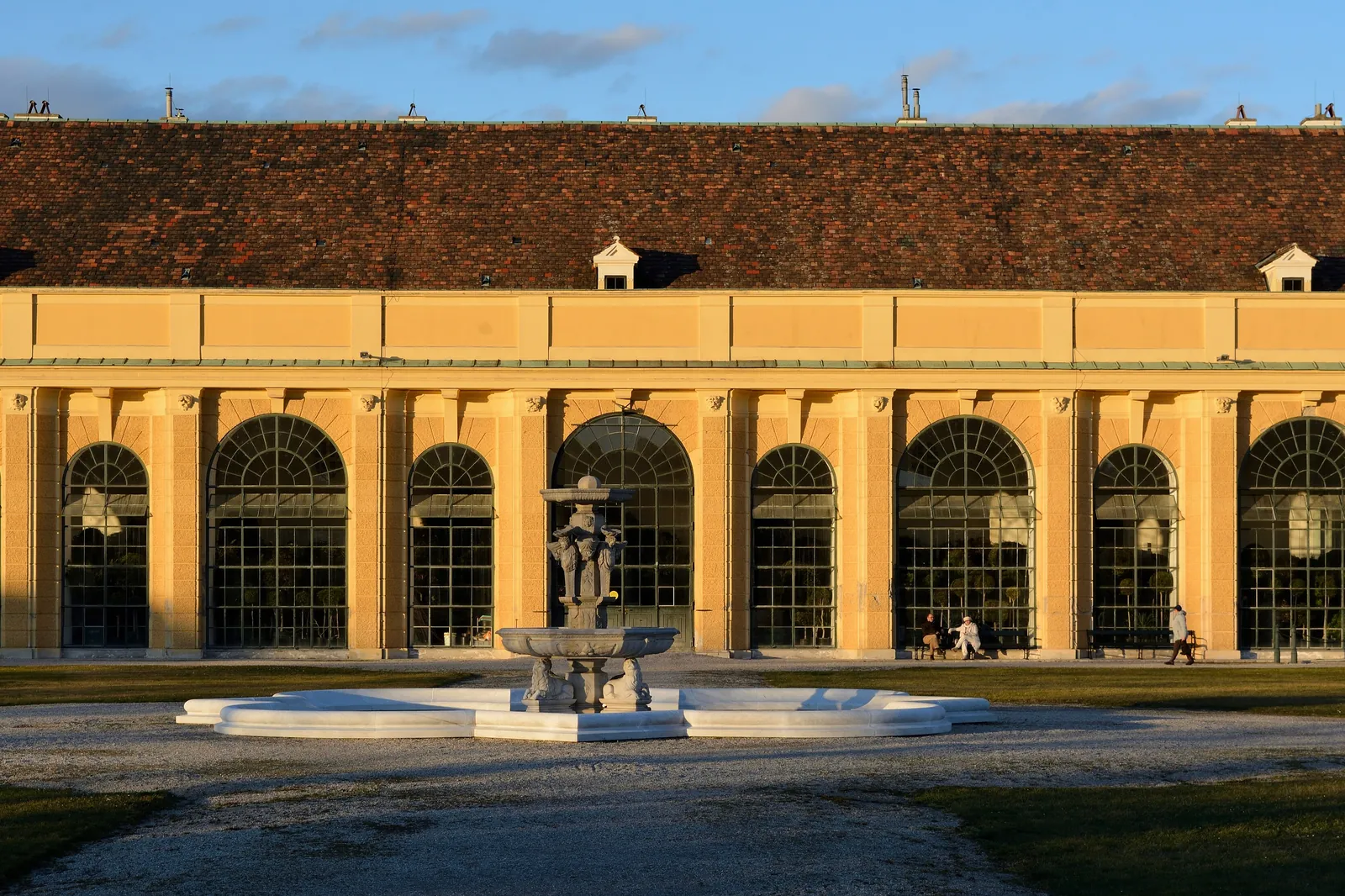
Schönbrunn's history pages trace the Orangery to the dowager empress Wilhelmine Amalie, who kept an orangery garden here with a hothouse for tender citrus trees. In 1754 Franz I Stephan, husband of Maria Theresa, had the present building put up by Nikolaus Pacassi, probably to designs by Nicolas Jadot. It is 189 metres long and 10 metres wide, one of the two largest baroque orangeries in the world alongside Versailles, and its floor is warmed by a hypocaust so that citrus trees and other tub plants survive the winter indoors.
The masks on the front
Walk along the south front before the concert and look up at the pilasters between the windows. Schönbrunn describes an alternating rhythm of large and small round-arched bays, separated by rusticated pilasters decorated with masks. The organiser's venue notes add that these carved faces are the only figurative sculpture on the building, and that they range from grotesque to smiling. They are easy to miss in the evening light, but they give the long, plain façade its character.
Banquets in winter
Joseph II, Maria Theresa's son, was especially fond of holding banquets in the plant-filled Orangery. Schönbrunn's pages say he was copying what he had seen in the winter garden of the imperial palace in St Petersburg on his trip to Russia. One such evening, on 6 February 1785, was billed as a spring festival on a winter's day. The idea was simple and theatrical: flowering plants and lit citrus trees inside, snow outside, and the court at table in between.
The 1786 contest
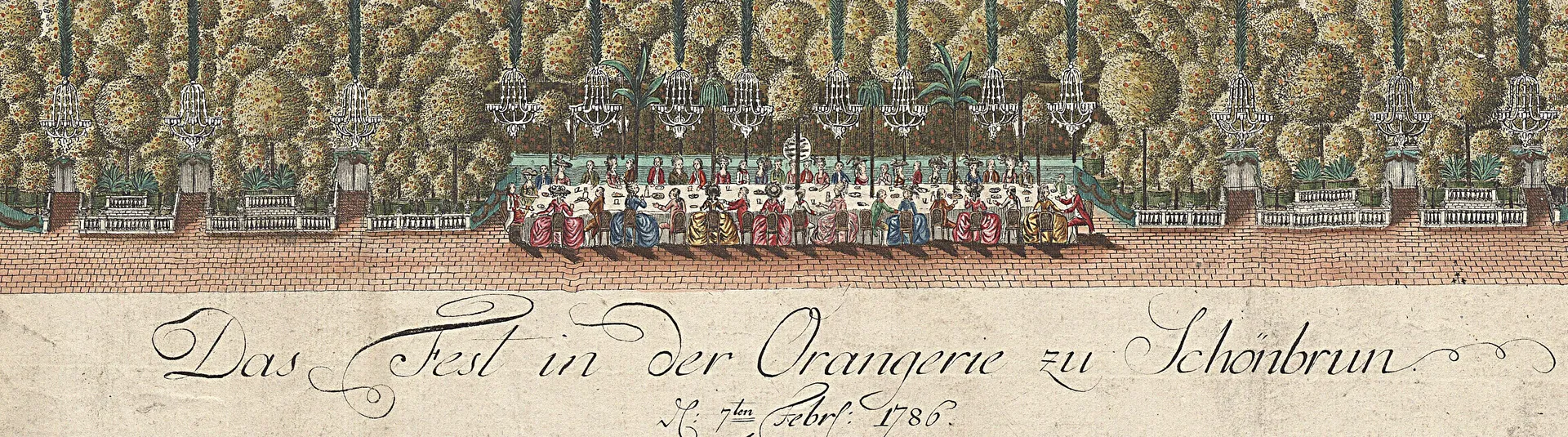
A year later, on 7 February 1786, the emperor turned a similar gathering into a musical competition. Wikipedia describes it as a private performance for his guests in which a German Singspiel faced an Italian opera buffa. Antonio Salieri's Prima la musica e poi le parole was sung at one end of the Orangery, and Mozart's Der Schauspieldirektor at the other. Mozart's piece pokes fun at the vanity of singers, with two rival singers trying to outdo each other with ever higher notes. Public performances of Mozart's entry followed days later at the Kärntnertor Theatre.
The boy at the harpsichord
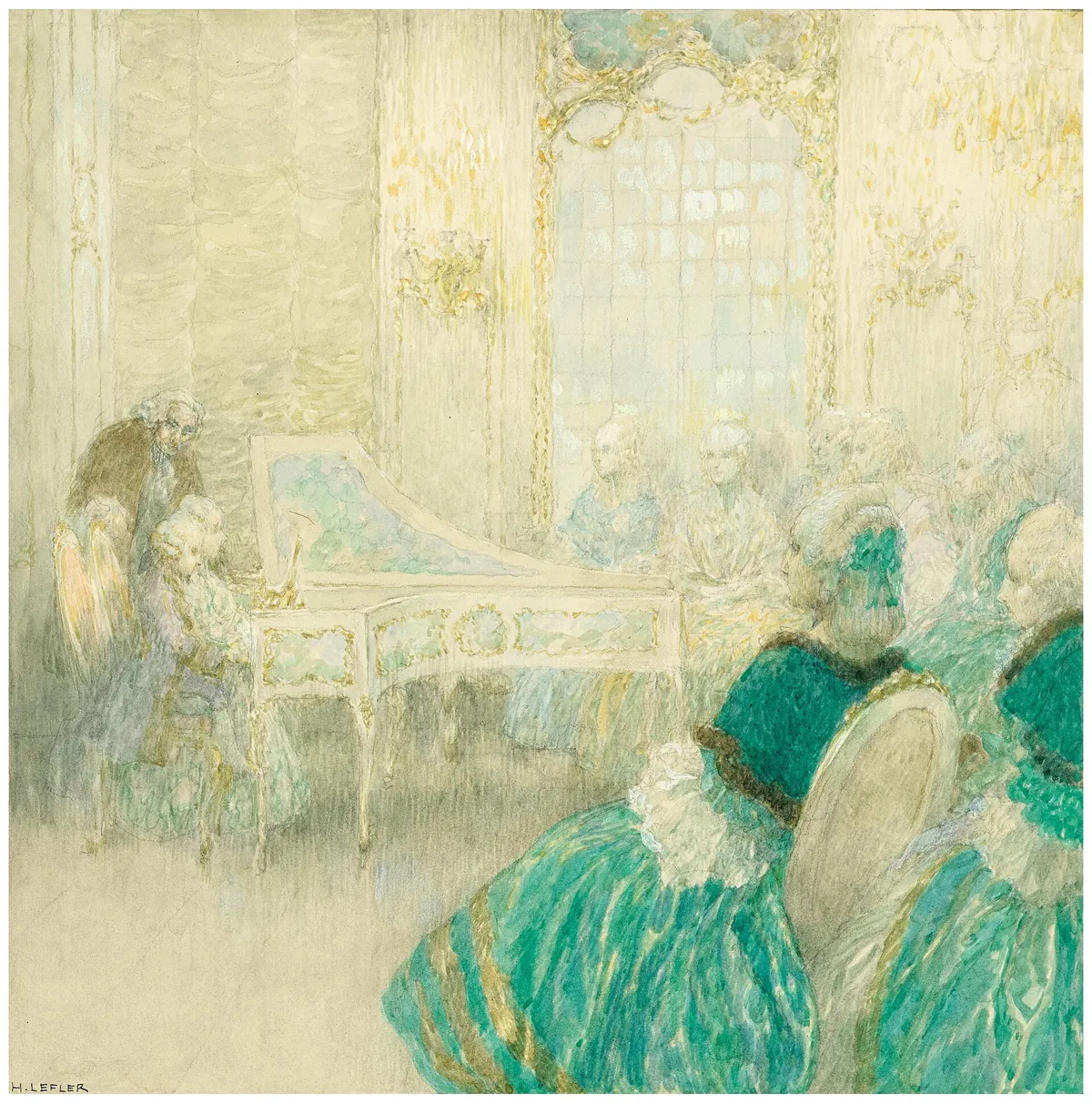
Mozart's link with Schönbrunn is older than the contest. In 1762 the six-year-old prodigy gave a concert for Maria Theresa at the palace. Schönbrunn's history pages say it is believed to have been in the Hall of Mirrors, and they quote his proud father's letter describing how, after the performance, the boy jumped onto the empress's lap and covered her with kisses. That boyhood concert took place in the main palace building rather than in the Orangery.
From horses to concerts
The building's later history was less glamorous. The organiser's venue notes say that imperial troops were quartered at Schönbrunn in the autumn of 1848 and the Orangery served as a stable for their horses, and that after the Second World War it was partly converted and shortened inside to make room for a heating plant. Restoration began in 1985. Today a glass wall divides the hall: the longer part towards the palace is a greenhouse again, and the end near the Meidling gate is the concert and event space.
Who this isn't for
History is the backdrop here, not the programme. The concert does not restage the 1786 contest, and nothing guarantees that Der Schauspieldirektor or Salieri will be played on your night. If the history is the main draw, read up before you go and use the interval to look along the hall and out at the garden.
Frequently asked questions
Did Mozart really perform in the Schönbrunn Orangery?
His opera Der Schauspieldirektor was staged there on 7 February 1786, in a contest with Salieri arranged by Joseph II. As a six-year-old in 1762 Mozart played for Maria Theresa in the main palace, believed to be in the Hall of Mirrors.
How big is the Orangery?
It is 189 metres long and 10 metres wide, one of the two largest baroque orangeries in the world alongside the one at Versailles.
Is the Orangery heated in winter?
Yes. A hypocaust system warms the floor so that citrus trees can overwinter inside, and the concerts run indoors all year in a warm hall.
Sources